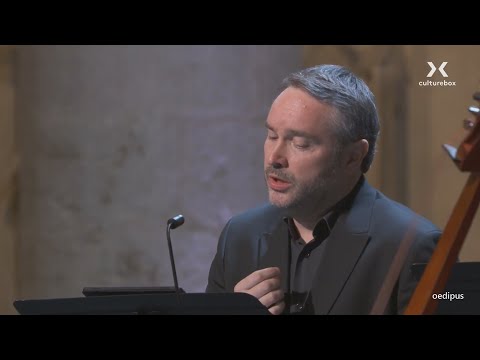
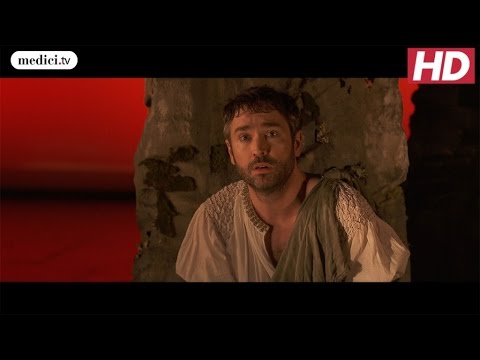
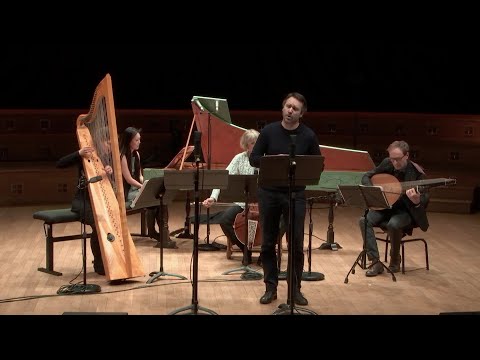
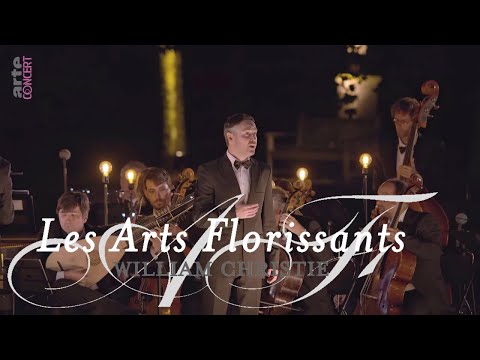
Cyril Auvity began his career under the guidance of William Christie, making his debut as Telemaco in Monteverdi’s Il ritorno d’Ulisse in patria at the Festival d’Aix-en-Provence in 2000 before reprising the role at theTeatro Real in Madrid.
Praised by the press for his “impeccable technique, the natural beauty of his tone, the clarity of his diction and, above all, the emotion he conveys through his singing” (ResMusica), he has established himself as one of today’s leading French haute-contre tenors, particularly renowned for his outstanding interpretations of the French Baroque repertoire.
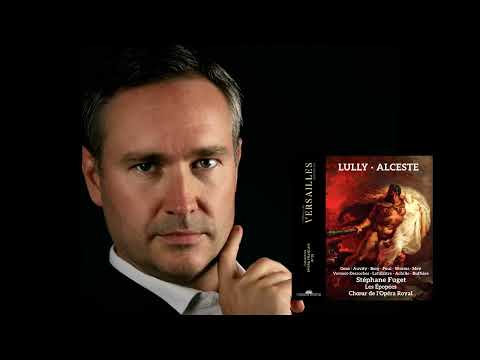
Cyril’s Lully repertoire includes the title role in Persée under Hervé Niquet in Toronto, Renaud in Armide with Vincent Dumestre and Le Poème Harmonique at the Opéra Royal de Versailles, the Philharmonie de Paris, the Théâtre du Capitole de Toulouse, the Teatro Real in Madrid and the Opéra de Dijon, and, more recently, Admète in Alceste with Les Épopées under Stéphane Fuget at the Théâtre des Champs-Elysées.
His affinity with Rameau’s music has led him to portray the title role in Pygmalion at the Théâtre du Châtelet, Valère and Tacmas in Les Indes galantes at the Bayerische Staatsoper in a production by Ivor Bolton and Sidi Larbi Cherkaoui, and at the Grand Théâtre de Genève under Leonardo García Alarcón in a new Lydia Steier staging, and Thespis and Mercure in Robert Carsen’s acclaimed staging of Platée at the Theater an der Wien. Add to this Les Fêtes d’Hébé at the Opéra Comique under William Christie, once again in a Robert Carsen production.
Among Cyril Auvity’s other notable French Baroque roles are the title role in Charpentier’s David et Jonathas with Les Arts Florissants under William Christie, presented on an international tour including the Chapelle Royale in Versailles, the Lucerne Festival and Buenos Aires’ Teatro Colón, Jason in Charpentier’s Médée under Leonardo García Alarcón in David McVicar’s production at the Grand Théâtre de Genève, and Ceix in Marin Marais’s Alcione at the Opéra Comique under Jordi Savall.
Cyril has also cultivated a strong presence in Italian Baroque opera. He has sung Emilio in Handel’s Partenope under Ottavio Dantone at the Teatro Comunale di Ferrara and the title role in Monteverdi’s L’Orfeo with Les Arts Florissants under Paul Agnew, in a production premiered at the Théâtre de Caen before touring to the Musikverein in Vienna, the Opéra Royal de Versailles and the Philharmonie de Paris (released on DVD by Harmonia Mundi). He appeared in Emilio de Cavalieri’s La Rappresentatione di anima e di corpo under Giovanni Antonini and in Stefano Landi’s La morte d’Orfeo under Stéphane Fuget, both at the Theater an der Wien. He also collaborated with Christina Pluhar and L’Arpeggiata in Il Combattimento, a musical creation inspired by Monteverdi and his contemporaries, presented at the Grand Théâtre de Genève.
Under Emmanuelle Haïm’s baton, he sang the title role in Charpentier’s Actéon at the Aldeburgh Festival and Bacchus in Lully’s Thésée in Jean-Louis Martinoty’s production at the Théâtre des Champs-Elysées and the Opéra de Lille.
His long-standing collaboration with Christophe Rousset has proved equally fruitful. With Les Talens Lyriques, he has appeared in Rameau’s Platée at the Opéra national du Rhin, Cavalli’s La Calisto at the Théâtre des Champs-Elysées, as well as Rameau’s Les Indes galantes at the Opéra national de Bordeaux and Théâtre du Capitole de Toulouse. Their artistic partnership is also documented through several recordings of Lully’s operas, including Bellérophon, Amadis, Isis and Acis et Galatée.
Cyril Auvity’s repertoire further includes Purcell’s King Arthur with Hervé Niquet and Le Concert Spirituel at the Opéra national de Bordeaux and the Théâtre des Champs-Elysées, as well as Proteo in Sebastián Durón’s Coronis with Vincent Dumestre and Le Poème Harmonique at the Teatro Real in Madrid. He sang Don Ottavio in Don Giovanni under the baton of Emmanuel Krivine at the Cité de la Musique in Paris as well as Tamino in Die Zauberflöte under Hervé Niquet at the Opéra national de Montpellier. He also turned to contemporary opera, appearing as the Cabaret Director in Philippe Boesmans’s Pinocchio, conducted by Paul Daniel and staged by Joël Pommerat at the Bordeaux Opera.
His extensive discography includes the solo album “Stances du Cid” (Glossa), awarded a Diapason d’Or, Charpentier’s La Descente d’Orphée aux Enfers, and “Pathodia sacra et profana”, a recital devoted to Constantijn Huygens.
In the 2026/2027 season, Cyril Auvity will team up with Stéphane Fuget/Les Epopées for Monteverdi’s L’Orfeo at the Théâtre des Champs-Elysées, and with Hervé Niquet/Le Concert Spirituel for Purcell’s King Arthur at the Capitole de Toulouse, as well as for a series of concerts dedicated to Charpentier in Monte-Carlo and Versailles.
Cyril will return to the Theater an der Wien for Lully’s Carnaval under Federico Maria Sardelli.